Choose the wrong metal for a cantilever gate and nothing happens. Not at first. The trouble tends to show up around year four, when the leaf drags a little in the rollers or orange streaks start running down from the bolts. Below, we'll go through what really separates aluminum from galvanized steel once the winters pile up: weight and the drive, salt and slush, rust bleed, and the coating spec, which deserves more of your attention than the paint color.
A ground rule. Nobody can honestly quote you a lifespan in years for either metal without seeing your site, and we won't pretend to.
The mechanisms, though? Those we can lay out. You weigh them against your own driveway.
Weight comes first, and it changes everything else
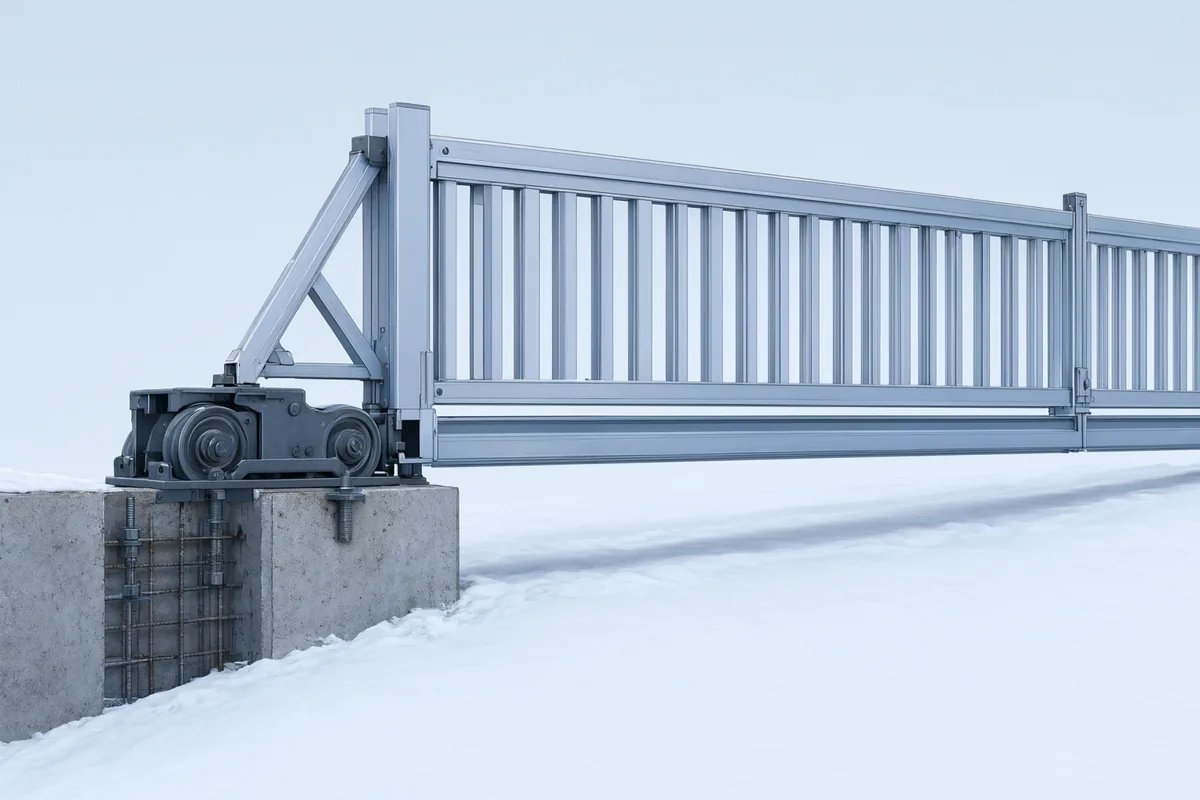
Steel is heavy. Aluminum comes in at about 2.7 g/cm3 against roughly 7.85 for steel, so a part of the same size weighs around a third as much. On a cantilever leaf that gap counts for more than on almost any other gate. There's no ground track underneath. Instead the leaf hangs off a carriage and balances over a tail that sits behind the opening. Our installation manual sets total gate length at 1.5 times the clear opening, so a 6,000 mm clearance gets a 9,000 mm leaf. Each extra kilogram in that span and tail lands on the rollers, the footing and the motor.
Steel handles a long span by being stiff. Aluminum gets there with section depth. Our bottom beam, a 6005-T6 extrusion, measures 302 x 213 mm with walls up to 7.0 mm; the top beam is 113 x 93 mm at 2 to 6 mm. We pick from four 6005-T6 beam profiles depending on leaf length, height, infill and load. That's how a single aluminum leaf clears 18 m, or 36 m bi-parting.
Where does drive load come in? Every start, and every stop. A heavy leaf carries more momentum, so the operator pushes harder to get it rolling and brakes harder at the end of travel. Picture a cold storage yard with the gate cycling every few minutes all night long. The gearbox feels each of those cycles, and so do the carriage wheels and the stops. We run a 500 W operator on a variable frequency drive at 18 to 22 m/min, with soft start and soft stop. Ramps like that help any leaf. With a lighter one, they've simply got less mass to fight.
Ten winters of salt: how each metal corrodes
Galvanized steel lives on its zinc. According to the American Galvanizers Association, that zinc protects in two ways. First, it's a barrier. And where the barrier gets scratched or cut, the zinc corrodes ahead of the exposed steel to protect it (cathodic protection). Repeated wetting and drying also builds a patina that, per the AGA, slows zinc corrosion to about 1/30th the rate of bare steel. That's real protection, and it's why guardrail and structural steel get galvanized.
The catch? Zinc gets used up. The AGA's method for estimating coating life ties it to coating thickness and environment, and it puts time to first maintenance at the point where about five percent of the steel surface shows rust. The chart is built on a model that accounts for salinity, rainfall and temperature, and marine climates sit on the shorter-life curves. Road salt, coastal spray and a rail that never quite dries all move the clock forward. Park the gate beside a plowed entrance and every storm throws slush at the bottom rail.
Don't lean on salt spray hours to compare, either. V&S Galvanizing points out that the continuous fog in a salt spray cabinet never lets the zinc dry and form its patina, so the test measures a surface that wouldn't exist in service.
Aluminum goes a different way. It grows a thin oxide film by itself and never makes red rust. Immune, it isn't: salty water trapped against a dissimilar metal can still pit it, so check the fasteners and the drainage. But nothing on the leaf is counting down.
Rust bleed shows up long before failure
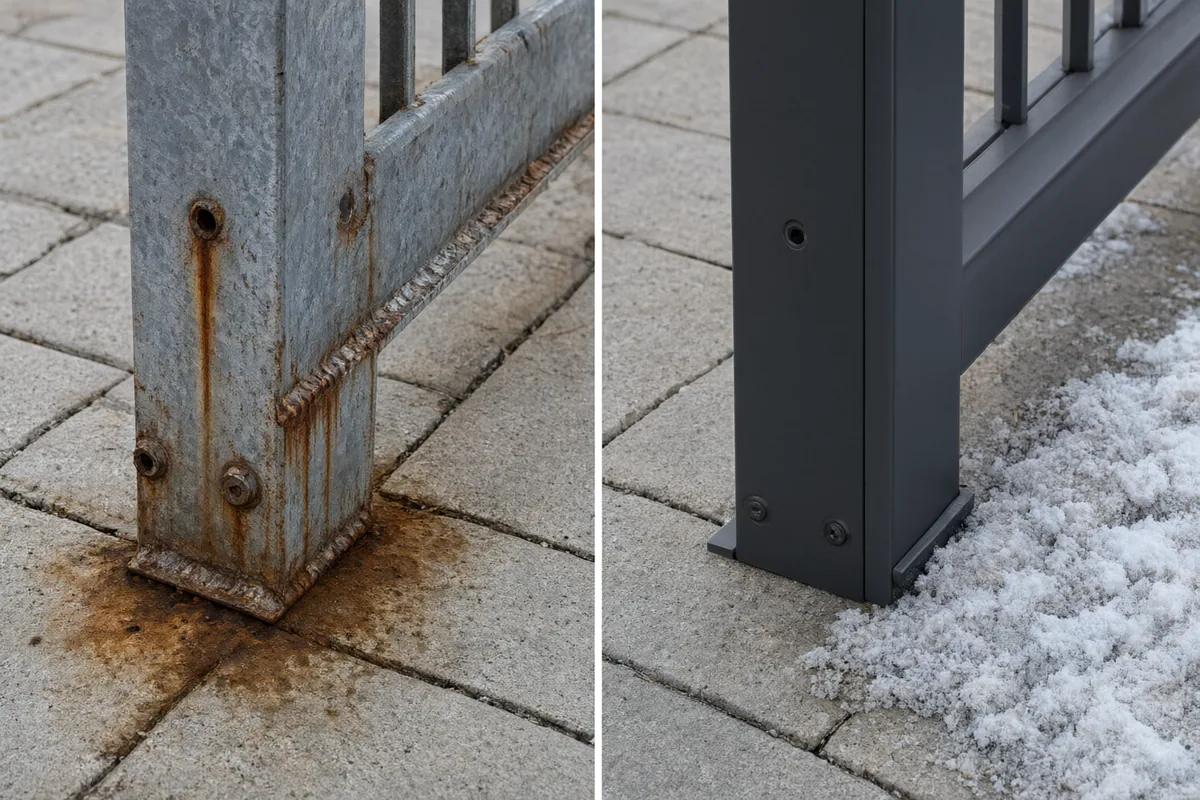
A galvanized gate rarely fails structurally inside its first decade. It just starts looking tired. Rust bleed is that reddish-brown stain running down from a weld, a drilled hole or a field-cut edge once the zinc there is spent. You can usually guess where it'll begin: holes drilled after galvanizing, welds touched up with zinc-rich paint, and the bottom rail where meltwater sits for days.
Don't shrug it off.
At a corporate entrance or a gated community, people notice stained pavers years before anyone thinks about section loss. Then someone's out there every spring with a wire brush and a spray can. Build the leaf from aluminum and the steel substrate is gone, red streaks included. You're left watching the hardware. On our gates that's a stainless steel pull-rod bracket, a heavy-duty cast steel pull-rod system and a 12-wheel carriage with top, bottom and side rollers. All serviceable parts. The full list is on our cantilever gate hardware page.
Coatings: what D1000, D2000 and AAMA actually tell you
Structurally, bare aluminum is fine. Most buyers still want a color. Standard on our gates is AkzoNobel Interpon D1000, a powder that meets AAMA 2603 and Qualicoat Class 1. Upgrade and you get Interpon D2000, a superdurable powder meeting AAMA 2604 and Qualicoat Class 2. Either one goes through a two-coat, two-bake high-temperature cure, and custom RAL colors are available.
Keep in mind what those specs test: the powder, not a finished gate. For D1000, the AAMA 2603 program covered color, gloss, film hardness, adhesion, impact, chemical resistance, humidity, salt spray and one year of South Florida exposure at 45 degrees facing south, and the exposure samples passed (Q-Lab ran the testing). D2000's AAMA 2604 program stretches to five years in South Florida. To pass, color change can't exceed 5 delta E, chalking must be no worse than No. 8, and gloss retention has to stay at 30% or better.
So which one? If your gate faces south in a sunbelt state, or has to match a building facade, go D2000. A gray gate behind a warehouse in a cloudy northern town will usually be fine on D1000. Honestly, the coating class matters more than whatever shade you pick.
You can powder coat galvanized steel too. It's called a duplex system, and it works, though powder over zinc needs careful surface prep. Once the paint fails, you're back on the zinc clock.
Side by side: galvanized steel cantilever gate vs aluminum
| Factor | Galvanized steel leaf | Aluminum leaf (CAIMEN) |
|---|---|---|
| Weight for the same volume | Heavier, roughly three times aluminum | Roughly a third of steel; stiffness comes from deep 6005-T6 sections |
| Drive and roller load | More momentum on every start and stop | Less mass for the 500 W VFD operator to ramp |
| Corrosion protection | Sacrificial zinc, consumed faster by salt and wetting | Natural oxide film plus AAMA-tested powder |
| Rust bleed | Likely at welds, drilled holes, cut edges once zinc is spent | No red rust from the leaf; watch steel hardware only |
| Typical frame joints | Often welded | Modular bolt-together, less on-site welding |
| Repair after impact | Cut, weld, re-protect the zinc | Swap the damaged module |
Bolt-together frames, snow and footings
Lots of steel cantilever gates are welded frames. Every weld is a spot where long-term protection depends on whoever did the touch-up. Our aluminum leaves bolt together instead, with a modular tenon-and-mortise design that cuts down on site welding. Say a delivery truck clips the leaf in year six. You swap the damaged section. No cutting, welding or recoating in the field.
Then there's snow. With no ground track to pack with ice, a cantilever gate is a natural fit for heavy snow, sand and uneven ground. Our models sit 110 to 133 mm off the ground, and the operator is rated for -35 to +70 °C, subject to motor and configuration. Keep the plow berm out from under the leaf and it'll keep moving.
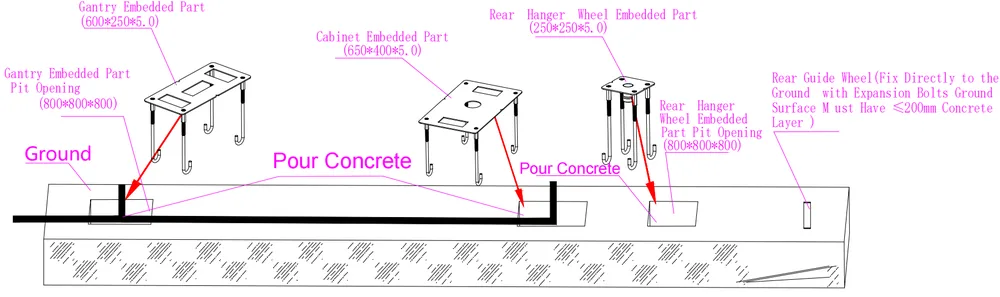
Your footing doesn't care which metal you pick. Our installation manual calls for an 800 x 800 x 800 mm pit in C20 concrete or better, with the cabinet, frame and hanger wheels held within plus or minus 10 mm of the same plane. A lighter leaf doesn't buy you a shallow footing. The installation page has the full sequence.
Which one fits your site?
Imagine a site on a salted county road in the upper Midwest. Trucks cycle the gate all night, and the facility manager would rather never repaint anything. That's the textbook case for an aluminum leaf on D1000, or D2000 if it catches the afternoon sun. Now flip it. A dry inland ranch, a gate that opens a few times a day, nobody fussed about looks: there, a well-galvanized steel gate can make sense, provided someone checks the welds and holes each spring.
Most commercial and industrial entrances sit nearer the first case. To size one, start with our aluminum cantilever gate page and the specifications. You'll get CAD drawings before production, which typically runs 15 to 20 days after drawing approval. Send your opening width and a few site photos to yifei@gmail.com, or use the contact page.
Sources
- American Galvanizers Association: Estimating the Life of Hot-Dip Galvanized Coatings
- American Galvanizers Association: Corrosion Protection (Galvanize It! Online Seminar)
- V&S Galvanizing: Why Salt Spray Testing Doesn't Work for Hot-Dip Galvanized Steel
CAIMEN product figures come from our installation manuals and engineering documentation.