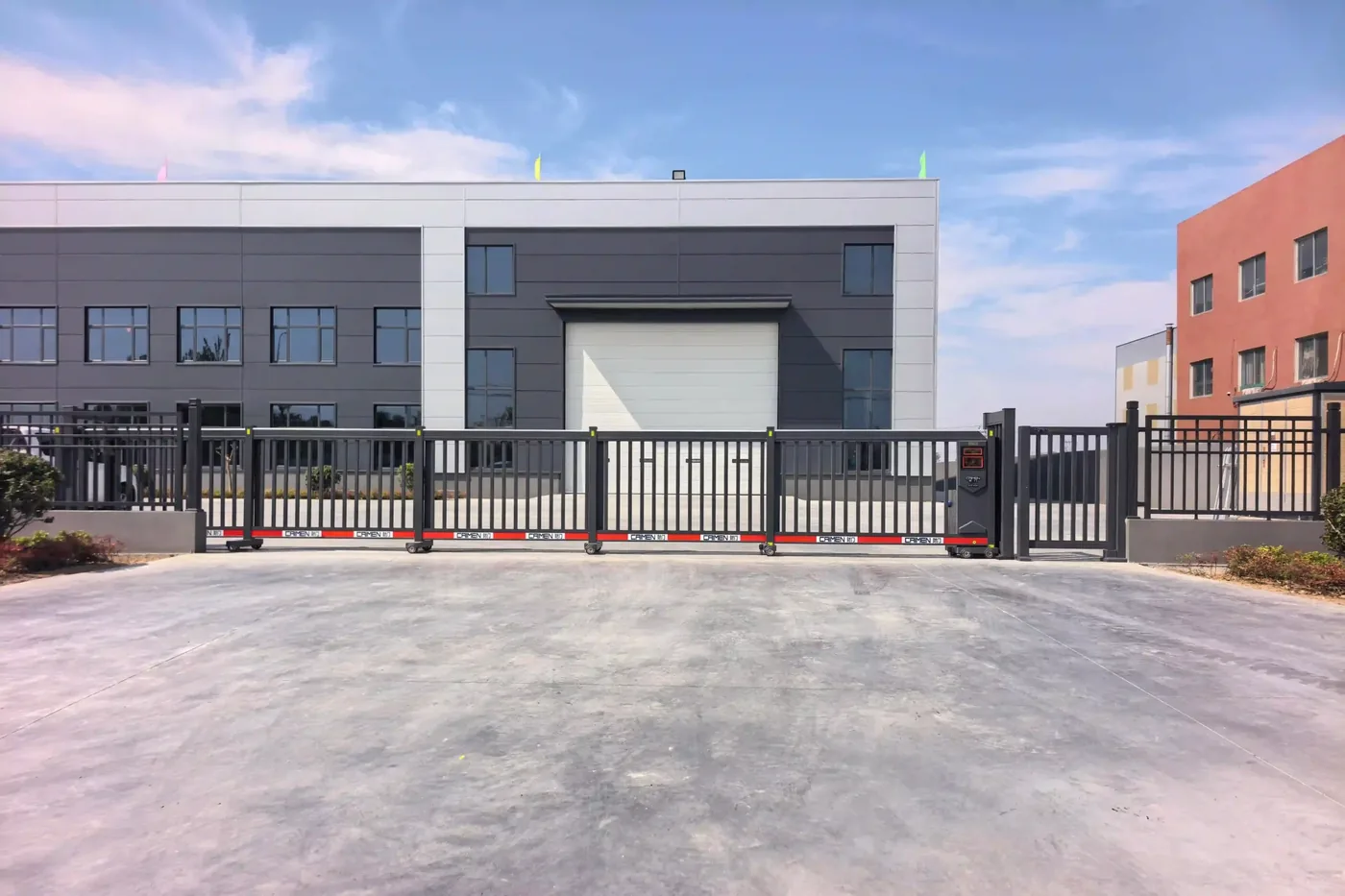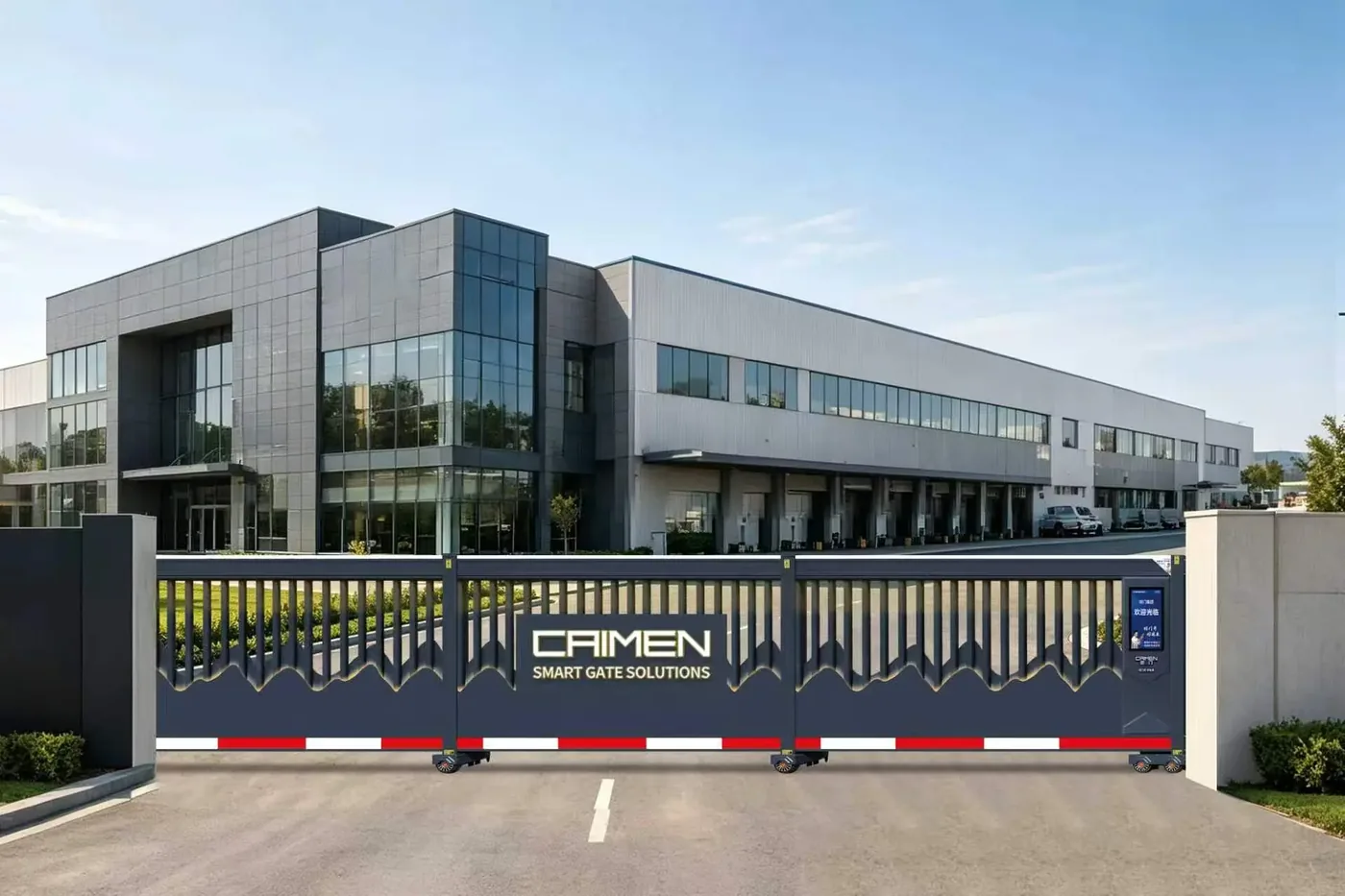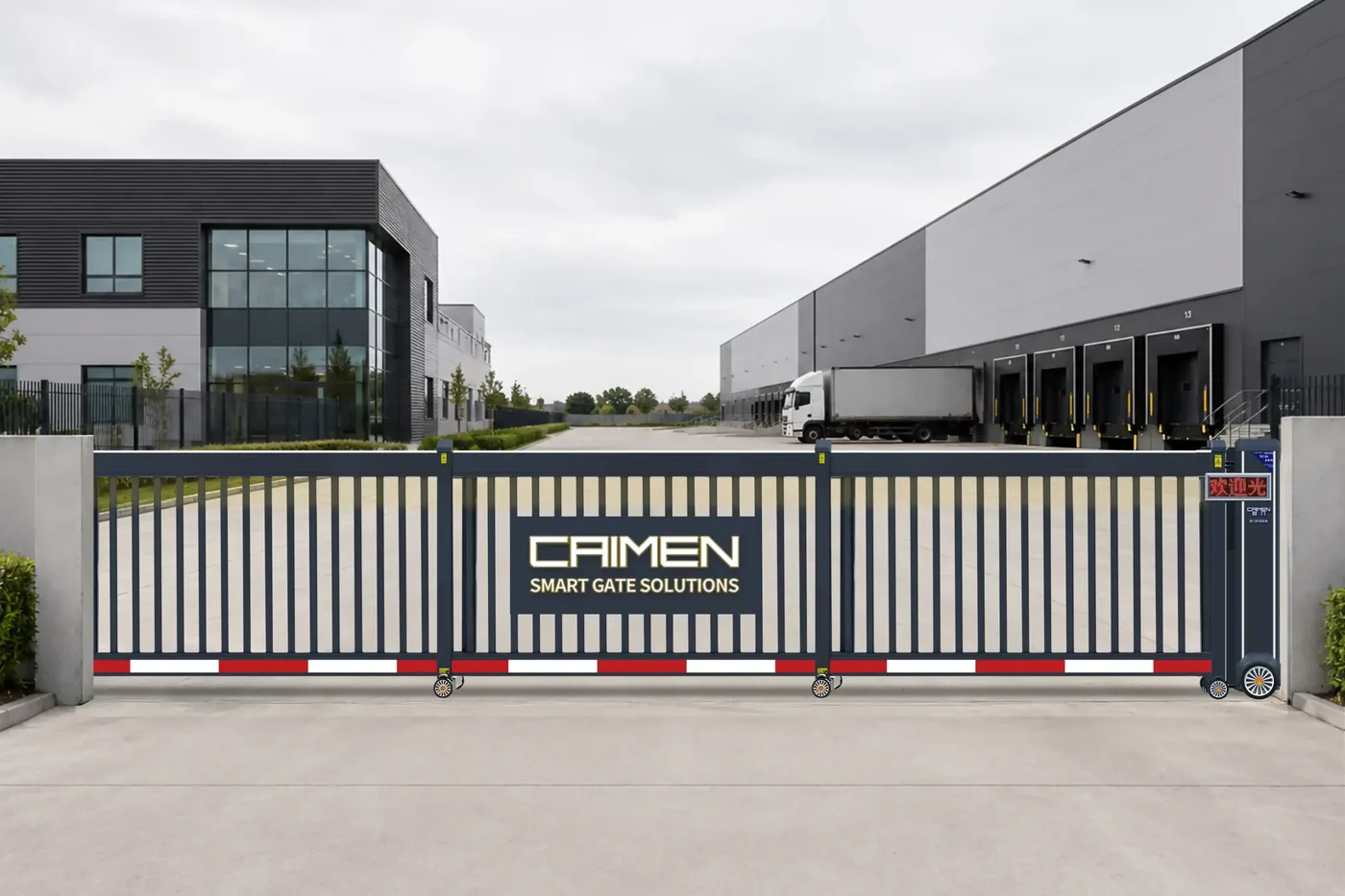
Most people size a cantilever gate by measuring the driveway. That's half the job. The other half is the strip of ground next to the opening, because the whole leaf has to slide into it, counterbalance tail and all. Come up short there and a fence post, a guard booth or your property line ends up choosing the gate for you.
Below you'll find the numbers we actually work from. There's the 1.5x rule, then the clearance table from our installation manual, then passage width, cabinet height and the fix for a cramped site.
Why a cantilever gate is longer than its opening
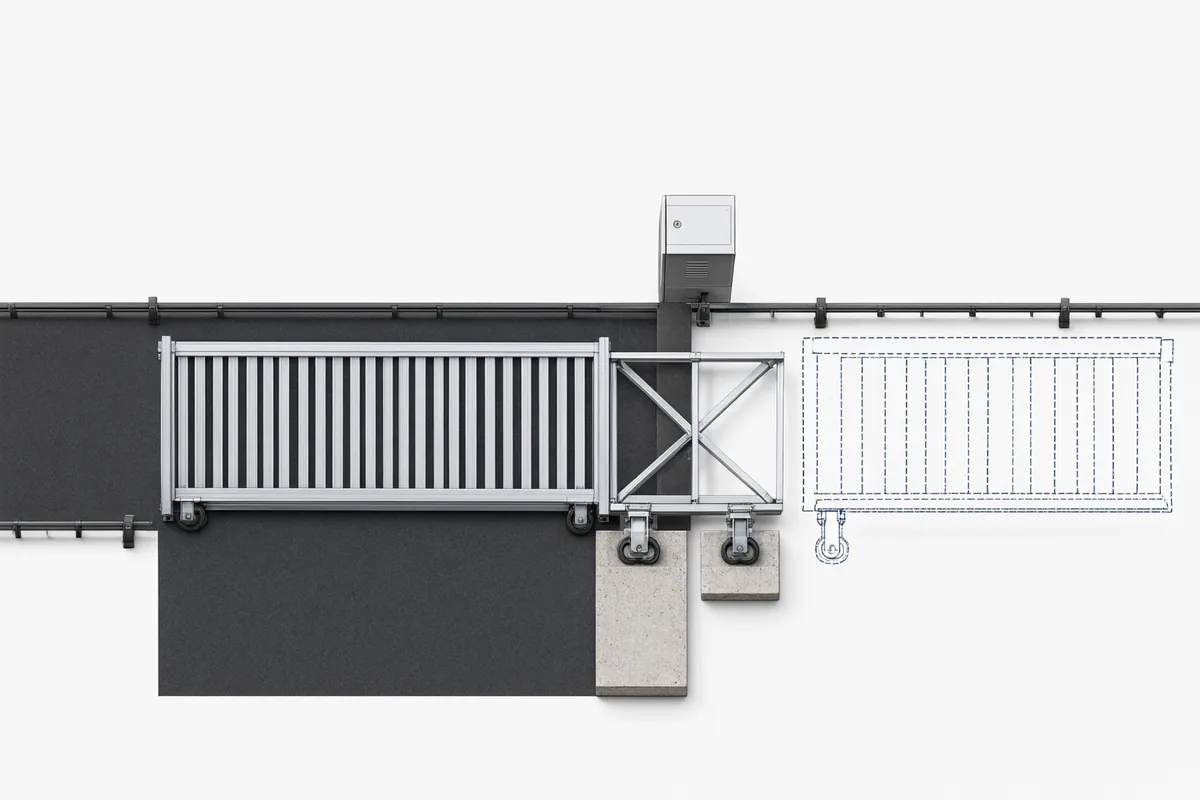
There's no rail across the drive. None. The leaf hangs on carriages mounted beside the opening, and a length of frame behind them (the counterbalance, or tail) stops the front end from sagging when the gate is closed across the span. Take the tail away and the leaf tips.
How long should that tail be? Hoover Fence's chain link cantilever installation manual says one half of the gate opening, with a 4 ft minimum, and warns that an automated operator may need more. The American Fence Company's buyer's guide lands in the same place: a cantilever slide gate runs approximately 50% larger than the opening it covers.
We follow the same logic. Look at any row of our sizing table and you'll see total gate length equals clearance times 1.5. So 4,000 mm (about 13.1 ft) of clearance means a 6,000 mm (about 19.7 ft) leaf. Got a 6,000 mm opening? You're looking at a 9,000 mm leaf, roughly 29.5 ft of aluminum frame.
The clearance table, row by row
We've copied this straight from our installation manual, millimeters throughout.
| Clearance | Total gate length | Hanger wheel distance | Guide wheel distance | Passage width |
|---|---|---|---|---|
| 3000 | 4500 | 1000 | 2000 | 2564 |
| 3500 | 5250 | 1250 | 2250 | 3064 |
| 4000 | 6000 | 1500 | 2500 | 3564 |
| 5000 | 7500 | 2000 | 3000 | 4564 |
| 5500 | 8250 | 2250 | 3250 | 5064 |
| 6000 | 9000 | 2500 | 3500 | 5564 |
| 6500 | 9750 | 2750 | 3750 | 6064 |
| 7000 | 10500 | 3000 | 4000 | 6564 |
| 7500 | 11250 | 3250 | 4250 | 7064 |
Read across a few rows and a pattern shows up fast.
- Length is 1.5x clearance, every time. There isn't a single exception, so it's safe to use the rule for a first estimate on in-between sizes.
- Passage width sits 436 mm below clearance on every row. That's your usable drive-through width with the gate open. Start from the vehicle and work back to the opening, never the reverse.
- Wheel spacing grows with the gate. Hanger and guide wheel distances each widen by 250 mm per 500 mm step in clearance, so the carriage positions spread out as the leaf gets longer.
Say your delivery vans need a clear 5 m lane. The 5,000 mm row won't do it; you'd only get 4,564 mm of passage. Jump to 5,500 mm and the passage becomes 5,064 mm, while the leaf grows to 8,250 mm. Those extra 750 mm of gate are the price of the wider lane, paid in side space.
So how much side space do you need?
Open the gate and the entire leaf slides clear of the opening and parks alongside it. Your straight, unobstructed run along the fence therefore has to be at least as long as the total gate length. Then add the motor cabinet and working room for your installer. With a 6,000 mm opening, you need 9 m of clear ground on the storage side before the cabinet even enters the picture.
Grab a tape and walk it. You're looking for:
- Fence posts, light poles or bollards sitting in the travel path
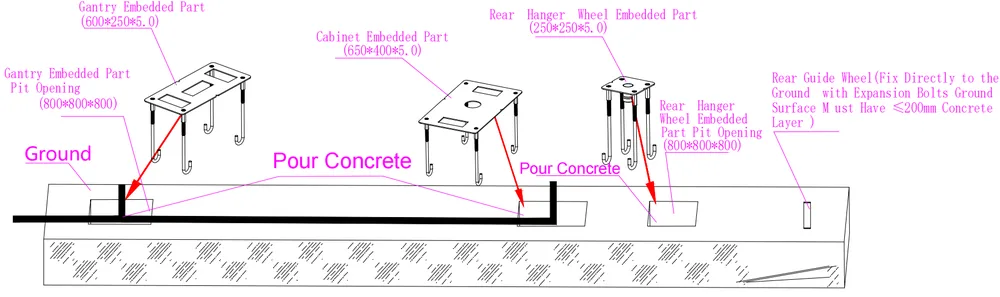
- Any slope or step in grade, since the cabinet, frame and hanger wheels must sit on the same plane within plus or minus 10 mm
- Room for the foundation, which our manual sets at an 800 x 800 x 800 mm pit with concrete no weaker than C20
- A boundary line, building corner or guard booth that cuts the run short
Grade is the one people underrate. A storage run that falls away 150 mm over 9 m will give you more grief than a tight one, because the frame and carriages need a level base to run true. Pour the concrete to fix it before the gate shows up. Afterward costs more.
Single gates have a ceiling, too. Ours reach a clear span of up to 18 m (59 ft), and the longest single leaf we deliver is 28 m (92 ft) overall. Do the math on 18 m: that's 27 m of leaf, so a full-size single gate wants close to 90 ft of straight storage. Lots of sites just don't have that. Beam profiles and drive data for those lengths are on the full specifications page.
When side space runs short: go bi-parting
If one side can't swallow a 1.5x leaf, split the gate in two. A bi-parting cantilever gate has two leaves meeting in the middle, and each one retreats to its own side. Because each covers only half the opening, each storage run is half as long. Bi-parting systems reach clear spans up to 36 m (118 ft).
Our Maldives airport perimeter project shows how this plays out. The international airport there needed a 22 m clear opening, and a single leaf would have opened too slowly for peak demand. We built two 11 m clear-opening leaves instead, each 16.5 m long, in 6005-T6 aluminum with a 7.0 mm bottom beam. Opening time dropped by half. Run our 1.5x rule on a single leaf and you'd also have needed about 33 m of frame, well past the 28 m we deliver in one piece.
You've got four opening modes to choose from in our installation manual, so the layout can follow the ground you actually have:
- Opposite opening: two leaves with centers offset by about 40 cm so they can't collide
- Double opening: two leaves on the same centerline, moving in sync
- Left single or right single: one leaf, stored on whichever side has room
Imagine a site with an 8 m opening, 7 m of clear run on the left and 6 m on the right. A single 12 m leaf fits neither side. Split it into two leaves covering 4 m each and every side needs just 6 m of storage. Done. There's more on how the two leaves are controlled on our bi-parting cantilever gate page.
Leaf height vs. cabinet height
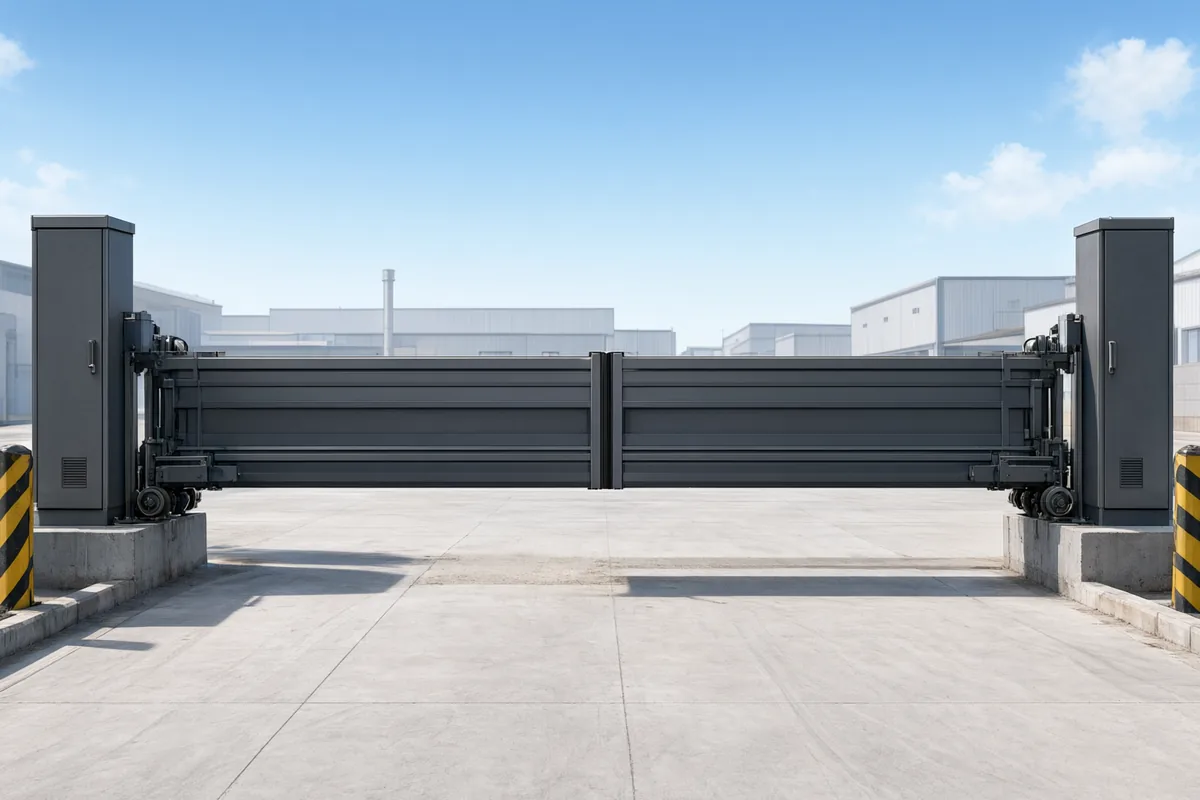
Length isn't the only thing to check. The motor cabinet stands beside the leaf and it's taller, which you'll care about if there's a low eave, a sign or a guard booth's sight line nearby.
| Leaf height (mm) | Cabinet height (mm) |
|---|---|
| 1600 | 1853 |
| 1700 | 1953 |
| 1800 | 2053 |
| 1900 | 2153 |
| 2000 | 2253 |
| 2100 | 2353 |
| 2200 | 2453 |
Notice the gap: 253 mm on every row. Under the leaf, ground clearance runs 110 mm to 133 mm depending on the model, so snow, gravel and little drifts of sand slip underneath rather than jamming a track. If your site needs it, custom leaves go up to 4.0 m tall.
A quick sizing checklist
- Measure the widest vehicle that has to pass, then add your own margin.
- Pick the clearance row whose passage width beats that number.
- Multiply that clearance by 1.5. It's your leaf length and your minimum storage run.
- Walk the storage side for obstacles, slope and foundation space.
- Short on one side? Check both sides for a bi-parting layout.
- Hold leaf and cabinet height up against anything overhead.
Send us the opening width, both side runs and a few photos. We'll come back with CAD drawings and renderings before anything goes into production, which typically takes 15 to 20 days after drawing approval. You can reach us through the contact page or at yifei@gmail.com.
Sources
- Chain Link Cantilever Gate Installation Manual (Hoover Fence)
- Buyer's Guide to Choosing a Cantilever Sliding Gate (The American Fence Company)
CAIMEN product figures come from our installation manuals and engineering documentation.