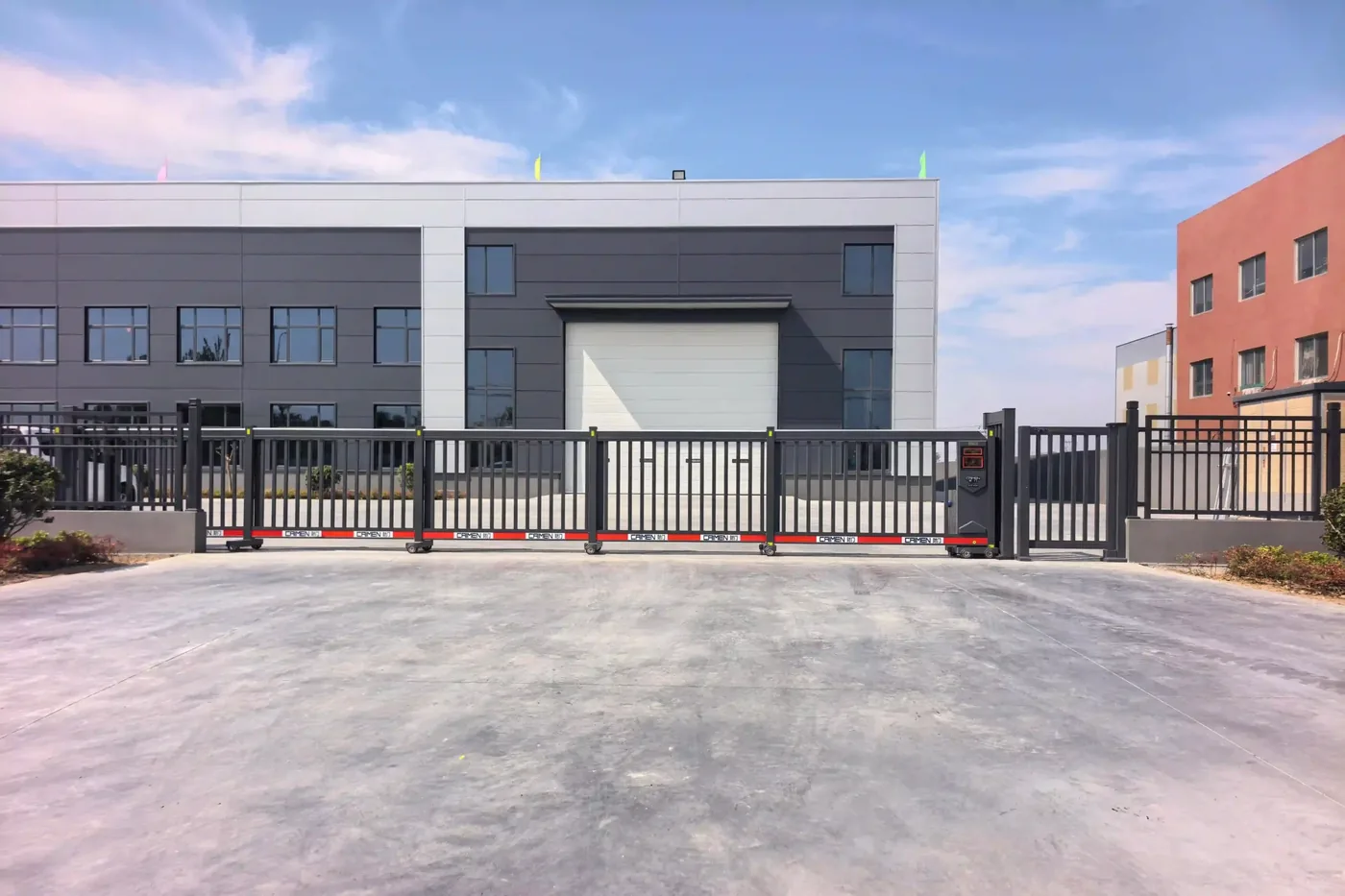
Most mornings, an industrial cantilever gate is just a big aluminum leaf sliding across a lane. Trucks use that lane. So do people. Say a driver climbs down from his cab to check a trailer seal just as the leaf starts rolling shut. Nobody's thinking about beam profiles then, or powder coat. The only question is whether the gate knows he's standing there. Good cantilever gate safety answers that with several layers, not one clever sensor.
CAIMEN builds five of those layers into its industrial cantilever gates. We'll go through each, say plainly what it catches and what it misses, then get to the UL 325 and ASTM F2200 questions US buyers always raise. Why stack devices at all? Every one of them has a blind spot.
Why one sensor is never enough
A sliding leaf doesn't create one hazard. It creates several, all at once. The closing edge can crush someone against the receiving post. Where the leaf runs past the drive cabinet and carriage, fingers get pinched. Some people just don't notice the thing is moving. And if the gate guards a perimeter, someone may try to climb it at 2 a.m.
You can't catch all of that with one kind of detection. Light beams react to a body crossing a line; a hand drifting toward a roller won't trip them. Contact edges? They only respond once something has already touched them. Guard bars keep working with the power off, though a pedestrian standing in the lane gets nothing from them. Combine the three and the gaps shrink fast.
Our view: on a busy logistics apron, the safety package matters more than the finish color. Give it the same weight in your spec as span and height.
The five layers at a glance
| Layer | Device | CAIMEN figure or behavior | Hazard it addresses |
|---|---|---|---|
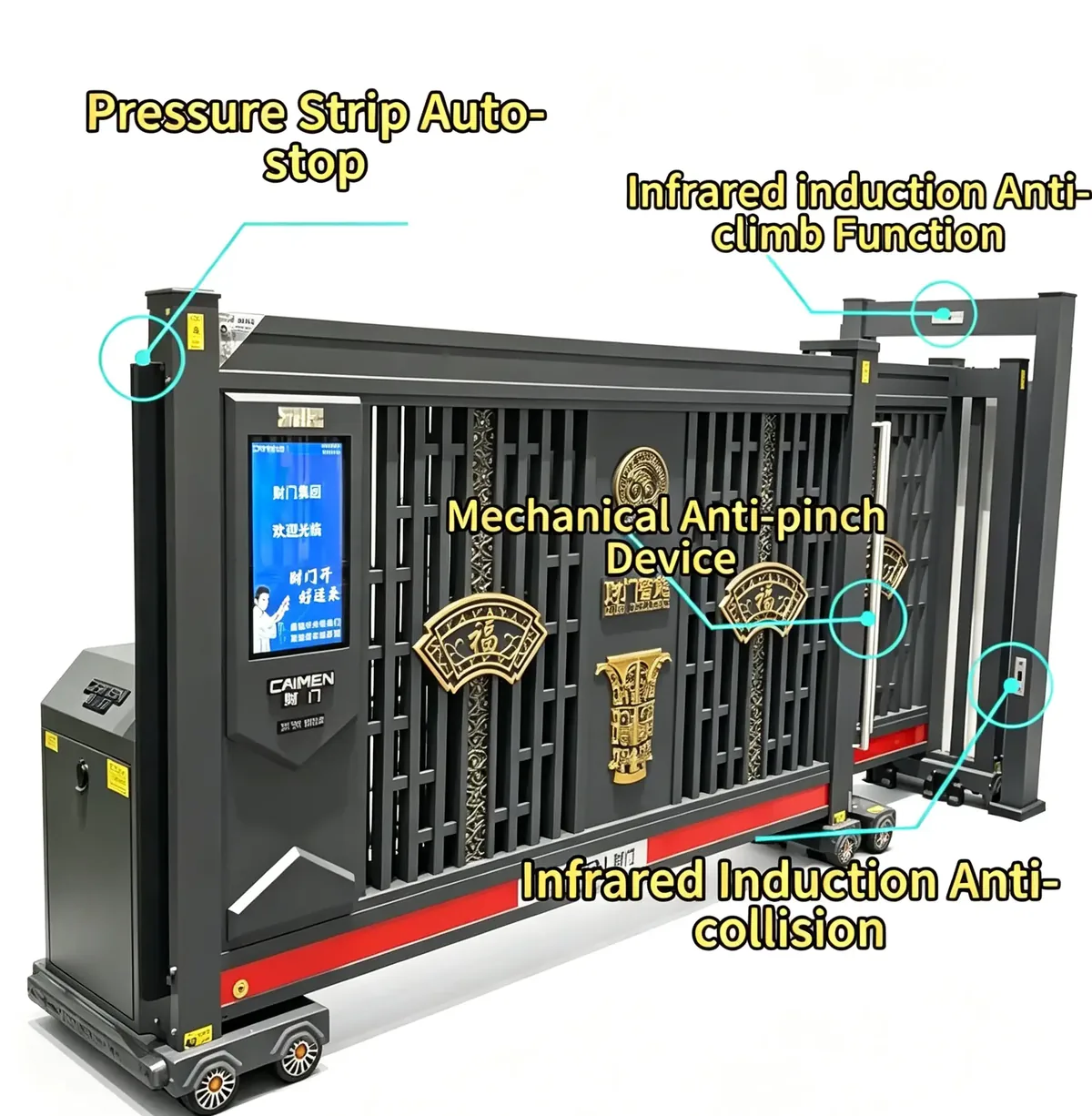
| 1. Non-contact sensing | Infrared photo-eye beams | Covers widths up to 20 m; stop and reverse when broken | A person or vehicle in the gate path |
| 2. Contact sensing | Pressure-sensitive safety edge on the leading edge | Signals the controller on contact | Crushing at the closing edge |
| 3. Mechanical guarding | Anti-pinch bars on both sides of the motor housing | Physical barrier, no power needed | Hands and fingers near the drive and carriage |
| 4. Overhead sensing and warning | Overhead sensor plus visual warning light | Light signals gate movement | People who don't realize the gate is moving |
| 5. Stop, release and hold | Emergency stop, manual clutch, self-locking drive | Clutch force 200 N or less; self-locking force 300 N or more | Power loss, rescue, forced pushing |
There's also an infrared anti-climb alarm sitting on top of those five. It's more a security feature than an injury one, so it gets its own note near the end.
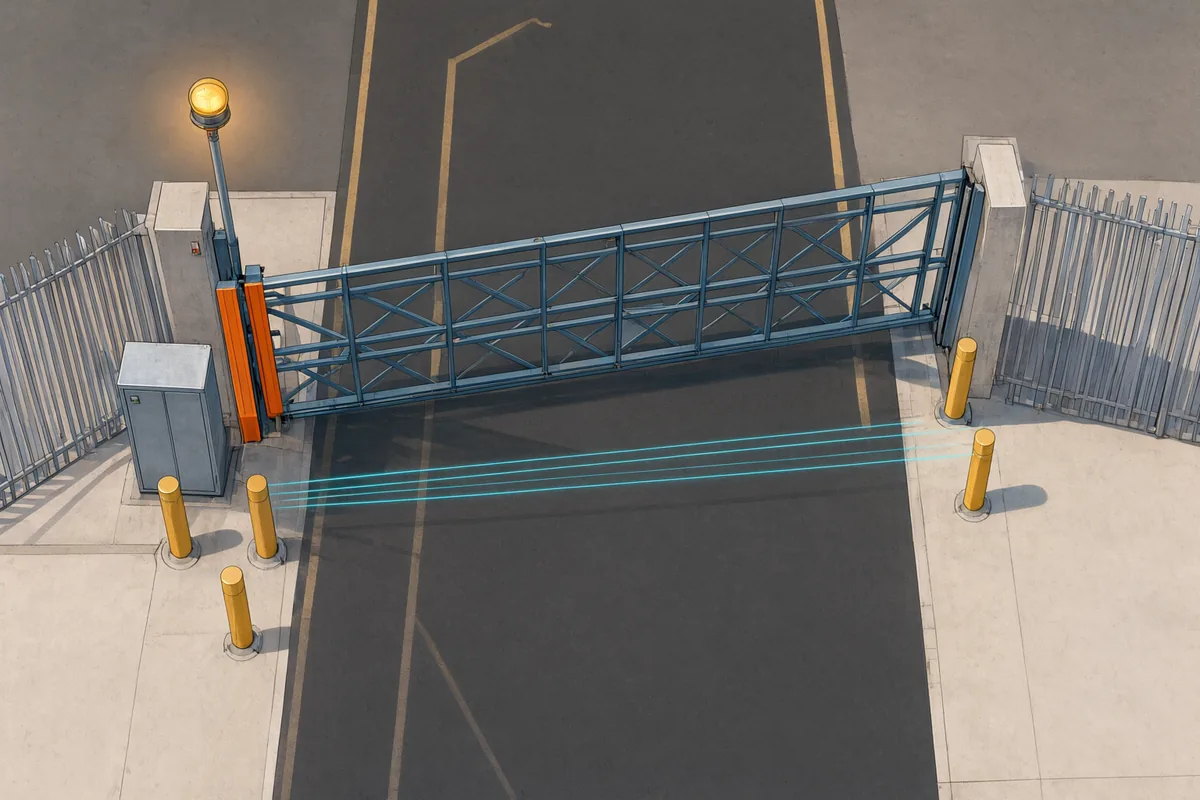
Layer 1: the infrared photo eye
Think of the infrared photo eye gate setup as your first line. A transmitter sits on one side, a receiver on the other. If anything breaks the beam while the leaf is closing, the controller stops it and reverses. CAIMEN's beams cover widths up to 20 m.
That figure is there for a reason. Our single-leaf cantilever gates reach clear spans up to 18 m, and the beam pair needs to cover the full opening, not just its middle. Mounting height counts just as much as reach. Too high, and a crouching worker slips underneath. Mount them low and a pickup's bumper can pass over before the cab ever registers.
Photo eyes aren't perfect. Dust gets on them. So does road spray, and low winter sun can blind a receiver. Put lens cleaning on the same checklist as roller greasing, and check the beam regularly by setting a box in its path while the gate closes.
Layer 2: the gate safety edge
The gate safety edge is a pressure-sensitive strip along the leaf's leading edge. Squeeze it and it tells the controller something's in the way.
Already have beams? You still want one. A beam only watches a line. Imagine a site where a worker is standing right beside the receiving post, between the two beam heights, fiddling with a padlock. The light stays unbroken. The edge won't miss him. It's the backup for everything the beam can't see.
Speed plays a part too. CAIMEN cantilever gates run on a 500 W variable frequency drive at 18 to 22 m/min, well below a slow walking pace, with soft start and soft stop. A leaf that ramps down instead of slamming makes any contact much gentler, and it gives the edge time to work.
Layer 3: mechanical anti-pinch protection
This one's low-tech. It may also be the most dependable layer you've got. Anti-pinch gate design simply puts metal between fingers and the spots where moving parts meet fixed ones. For CAIMEN gates, our installation manual specifies mechanical anti-pinch bars on both sides of the motor housing, exactly where the leaf runs past the drive.
No firmware. No wiring. The bars still work through a power cut or after a lightning strike, and that's why they earn their place: every electronic layer depends on power and a healthy controller.
Layer 4: overhead sensor and warning light
People react to what they see. A visual warning light flashing while the leaf moves tells drivers and pedestrians to wait, even the ones reading a delivery note or staring at a phone. Above the opening, the overhead sensor adds a second detection angle, so you aren't leaning on ground-level beams alone.
Sounds minor. Try saying that on a site with shift changes, foot traffic and forklifts crossing the same lane forty times a shift.
Layer 5: stop, release and hold
When something goes wrong, you need control back. Every CAIMEN cantilever gate has an emergency stop and a manual release. Our installation manual puts the manual clutch operating force at 200 N or less, so during an outage or a rescue one person can disengage the drive and push the gate by hand.
Then there's the reverse problem. A stopped gate shouldn't be easy to shove. The drive self-locks with a holding force of at least 300 N, which keeps a closed leaf from being forced open or drifting in the wind.
For maintenance, feed the gate through its own switch and a 6 A circuit breaker, and ground it properly. Lock that breaker out before anyone touches the carriage.
The bonus layer: infrared anti-climb
Night changes the risk. Instead of pinched fingers, you're worried about someone scaling the leaf, and that's what the infrared anti-climb alarm watches for. An intrusion sets off a 10-second alarm. Plenty of industrial sites pair it with a simple traffic plan: at peak hours the gate stays open while LPR and a high-speed barrier handle the flow, then off-peak it closes with anti-climb armed.
Our safety and access control page shows how these layers tie into access control.
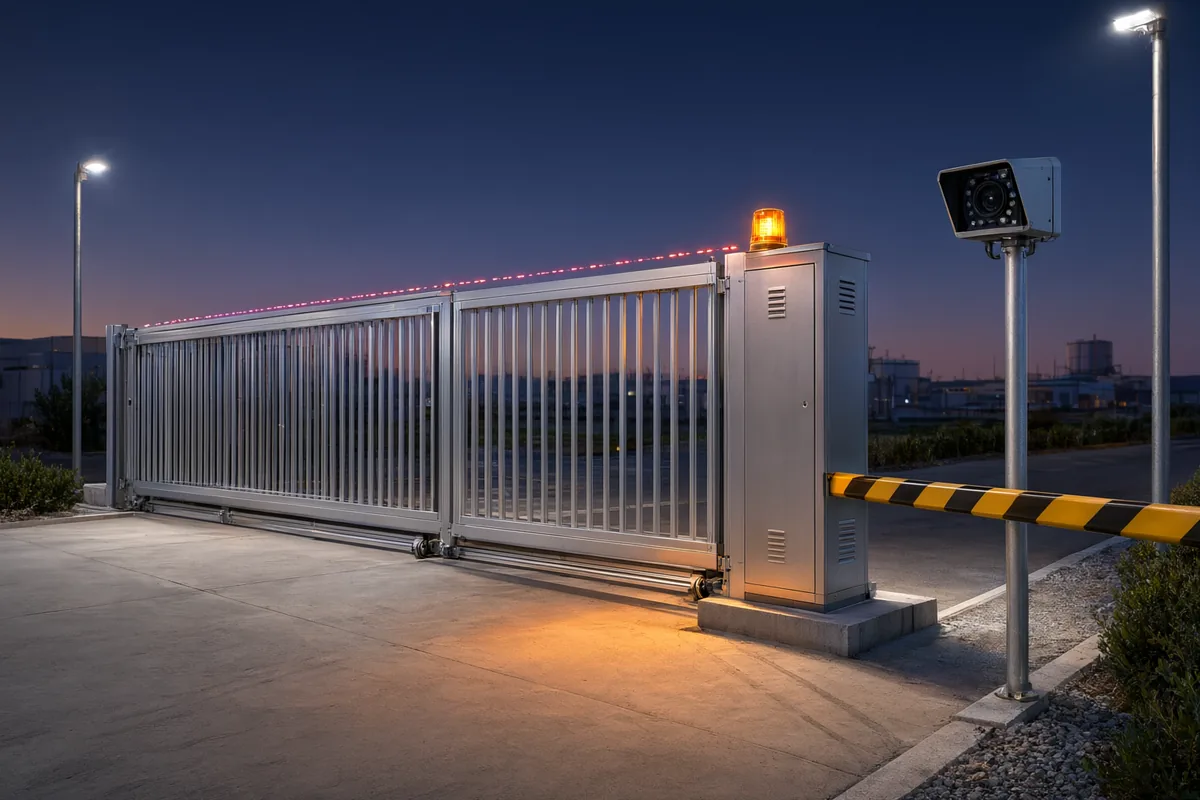
What US buyers ask about: UL 325 and ASTM F2200
Buying for a US site? Then two standards will come up in nearly every conversation, and they don't cover the same thing.
UL 325 deals with the gate operator, meaning the motor and controls. DoorKing's dealer reference guide summarizes a key change from the August 2018 update: slide gate operators need at least two independent means of entrapment protection in each direction of travel. Separately, UL 325 requires that photo-beams and contact edges used for entrapment protection be monitored. It also sorts installations into usage classes, running from residential up to restricted-access industrial sites.
ASTM F2200 is about the gate itself. DoorKing's gate safety overview lists what it asks of slide gates: guarded weight-bearing rollers, openings screened from the bottom to at least 72 inches so a 2.25-inch sphere can't pass through, no more than 2.25 inches of gap between the gate and fixed objects, positive stops, and a gate that won't fall if it comes off its hardware. Why 72 inches? DASMA's technical data sheet on F2200 explains that the 2011 revision raised the screening height from 48 inches to line up with UL 325.
Here's the straight answer. CAIMEN doesn't claim UL 325 listing or ASTM F2200 compliance for its cantilever gates. We send CAD drawings and specifications before production, and production starts only after you approve them. Your engineer or local inspector gets something concrete to check against whatever code your jurisdiction enforces. And you can ask for changes to infill or guarding while it's still a drawing.
A short checklist for your spec sheet
- List every entrapment zone: closing edge, drive cabinet, carriage, and any gap to a fence or post.
- Give each zone at least one device. A single photo eye can't stand in for everything.
- Check beam reach against your real clear span.
- Get the manual release force and the self-locking holding force in writing.
- Decide if you need anti-climb, and how it fits your night-time traffic plan.
- US site? Hand the drawings to whoever will judge code compliance before you sign off.
Spans, beam profiles and drive options are on our industrial cantilever gate page, and the full specifications are a click away. Got a specific site in mind? Reach us through the contact page or at yifei@gmail.com.
Sources
- Gate Safety (ASTM F2200 slide gate criteria) - DoorKing
- TDS 370: Rationale for ASTM F2200 Automated Vehicular Gate Construction - DASMA
- Dealer Reference Guide Section 6: UL 325 entrapment protection - DoorKing
CAIMEN product figures come from our installation manuals and engineering documentation.